Incident management
From detection to resolution, automatically.
Mihari connects your monitors, telemetry, error tracking and GitHub repositories to detect, diagnose and resolve incidents. They open on their own from a failing check and resolve when it recovers.
The complete incident lifecycle. Every step connected, on one timeline.
Detection
Monitors and heartbeats detect failures in real time and open the incident on their own.
Correlation
The AI SRE correlates logs, metrics and error tracking data to point at the root cause.
Resolution
The incident resolves when the check recovers. A proposed fix can go to GitHub as a draft pull request, validated by your CI.
Postmortem
The AI SRE drafts a root-cause analysis and postmortem from the incident timeline.
- Resolve on monitor recovery
- Auto
- Timeline per incident, end to end
- 1
- Lifecycle states — open, acked, resolved
- 3
- Alert channels for escalations
- 8
Automatic resolution
Resolve incidents before your team wakes up.
Link a monitor or heartbeat to telemetry and error tracking sources, and the AI SRE investigates the incident with that context, then posts the root cause to the timeline. When the check recovers, the incident resolves without human intervention.
- Link monitors and heartbeats to telemetry sources (logs, metrics, traces)
- Connect error tracking to identify the faulty code path
- Incidents resolve on their own when the monitor recovers
Linked sources
- Telemetry · logs & metricsapi-gateway / production Error spike
- Error trackingapi-gateway / Sentry SDK New errors
- GitHub repositoryacme/api-gateway Connected
AI SRE · root cause
Error spike correlates with deployment v2.8.1 (deployed 14:30 UTC). NullReferenceException in UserService.cs:142 matches the HTTP 503 pattern from telemetry logs.
GitHub integration
Proposed fixes, as draft pull requests.
Link monitors and sources to a GitHub repository. When the root cause is in your code, the AI SRE proposes a patch that you can open as a draft pull request on the linked repository.
- Link monitors, error tracking and telemetry sources to specific repositories
- Fix proposals based on the error tracking root cause analysis
- Draft pull requests go through your CI and code review before merge
fix: add null check in user.service.ts
- CI passing
- Opened from the AI SRE investigation
- Review requested · @yuki
Public status · your domain
A status page your users actually trust.
Branded, and hosted on your own domain.
- OperationalWeb app90d uptime · 99.998%
- OperationalPublic API90d uptime · 99.991%
- DegradedAuth / OAuth90d uptime · 99.842%
- OperationalWebhooks90d uptime · 99.996%
- OperationalDashboards90d uptime · 99.999%
- OperationalBackground jobs90d uptime · 99.988%
In the product
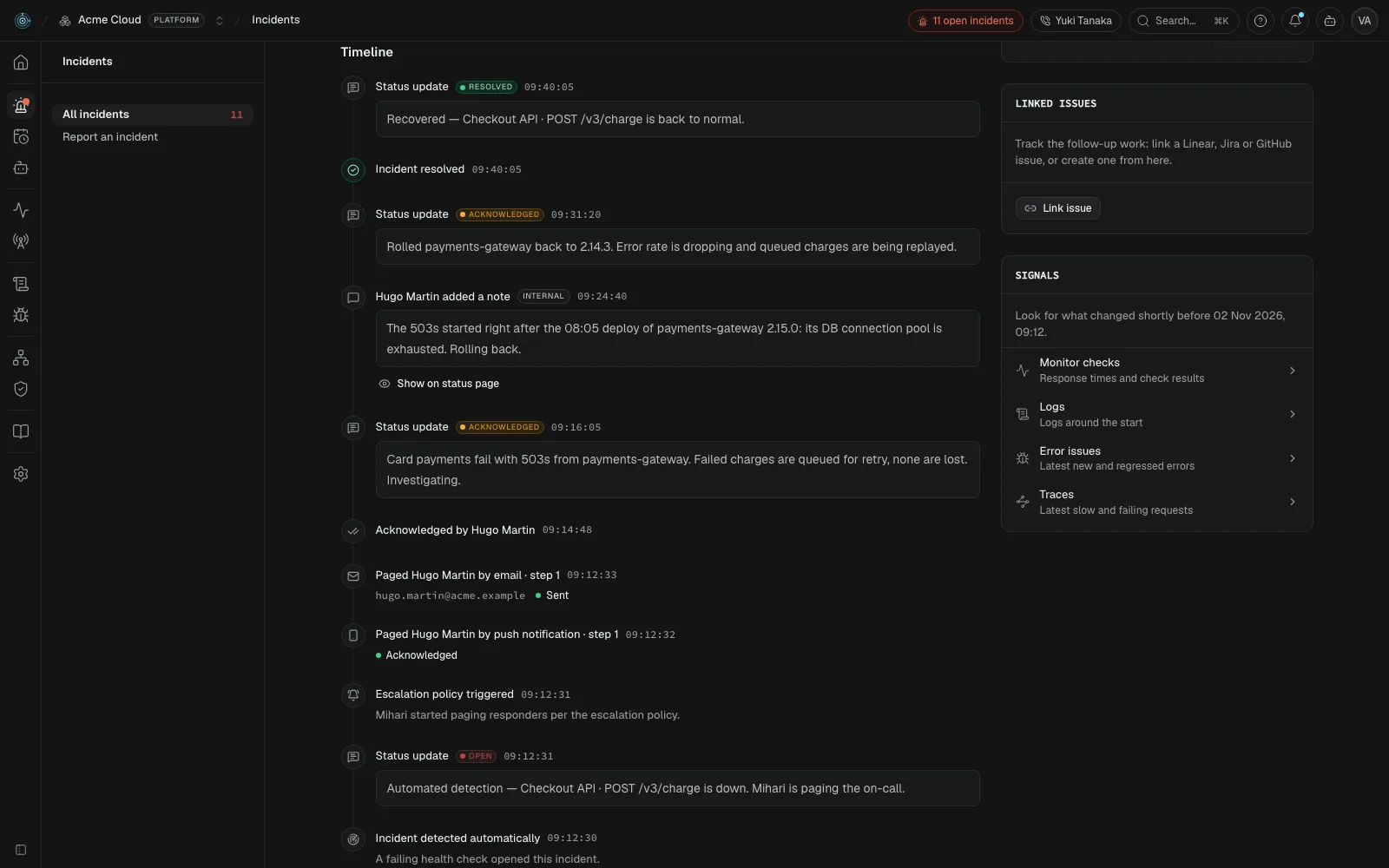
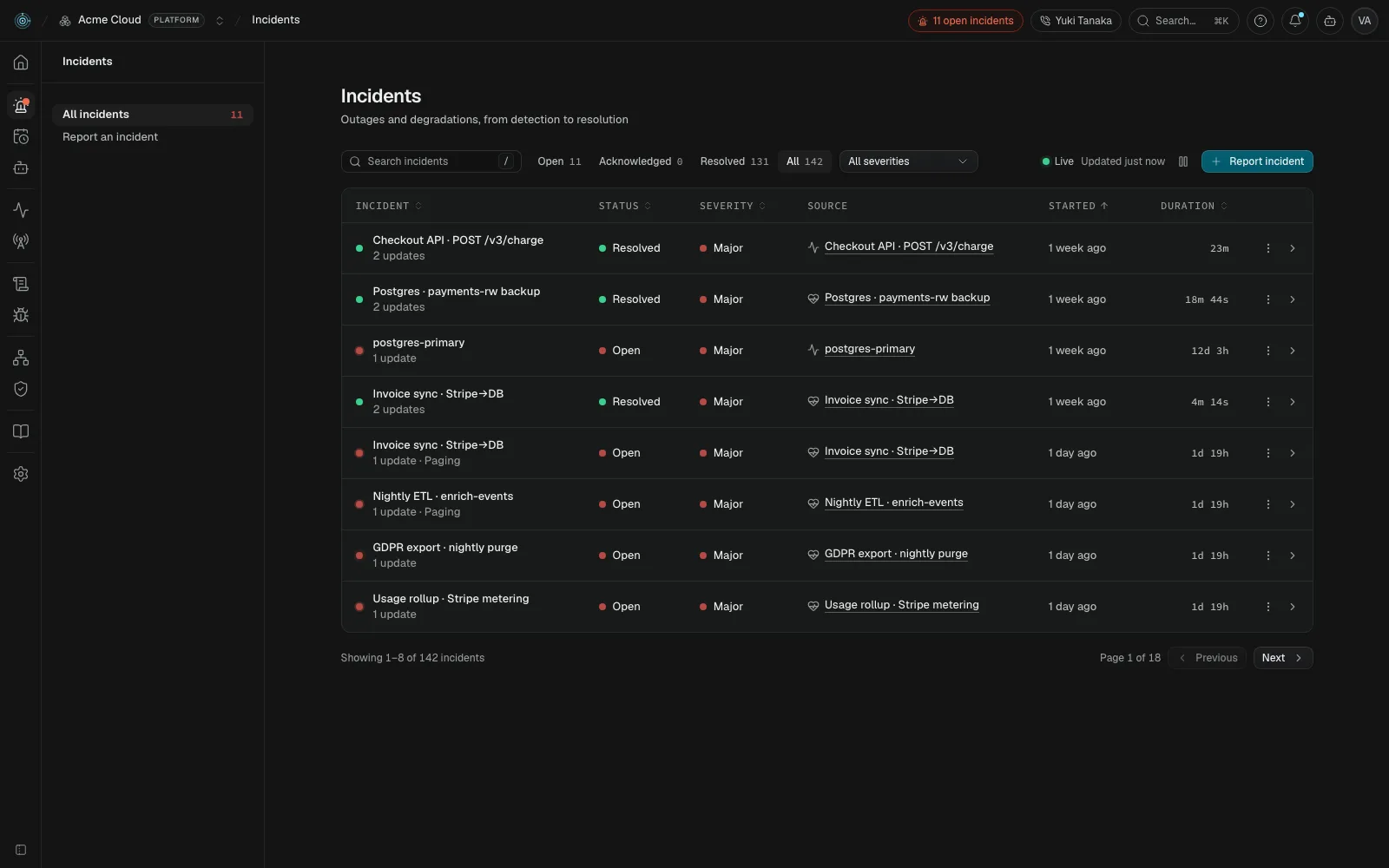
An incident, from detection to resolution
Every step lands on one timeline: detection, escalation, paging, recovery.
Frequently asked questions
Run your own post-incident review from our blameless postmortem template, in Markdown.
How does automatic incident resolution work?
Which Git providers are supported?
Are the proposed patches safe to merge?
Can I customize the postmortem template?
What telemetry and error tracking sources are supported?
Stop firefighting, start auto-resolving.
Connect your monitors, telemetry and GitHub repositories. Let Mihari detect, diagnose and document incidents for you.