Infrastructure
A cloud map you never hand a credential for.
The collector runs on your side, reads its own account or cluster, and pushes a signed inventory to Mihari. Mihari never holds a cloud credential and never dials your infrastructure — the map is drawn from what your agents and your CI sent.
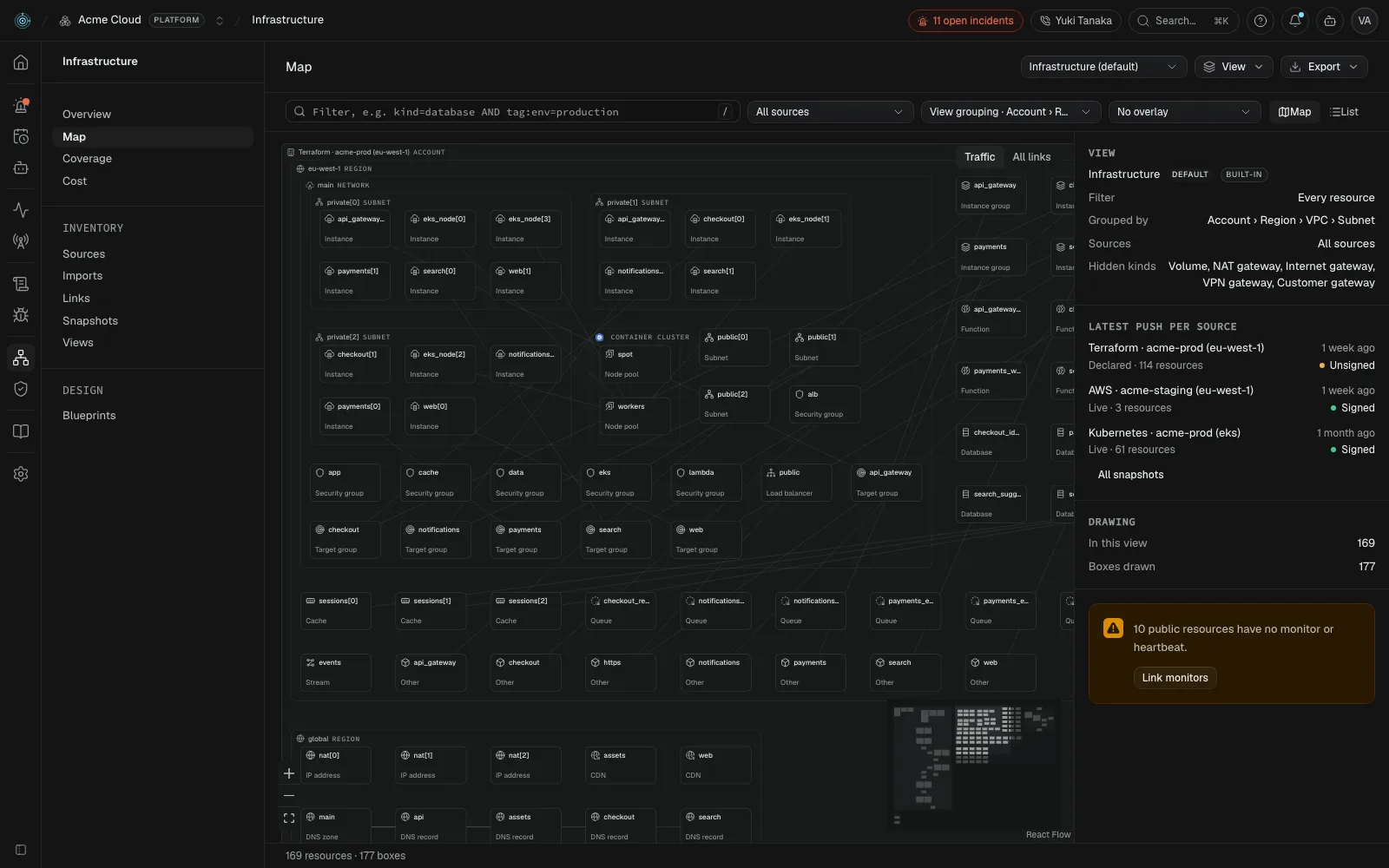
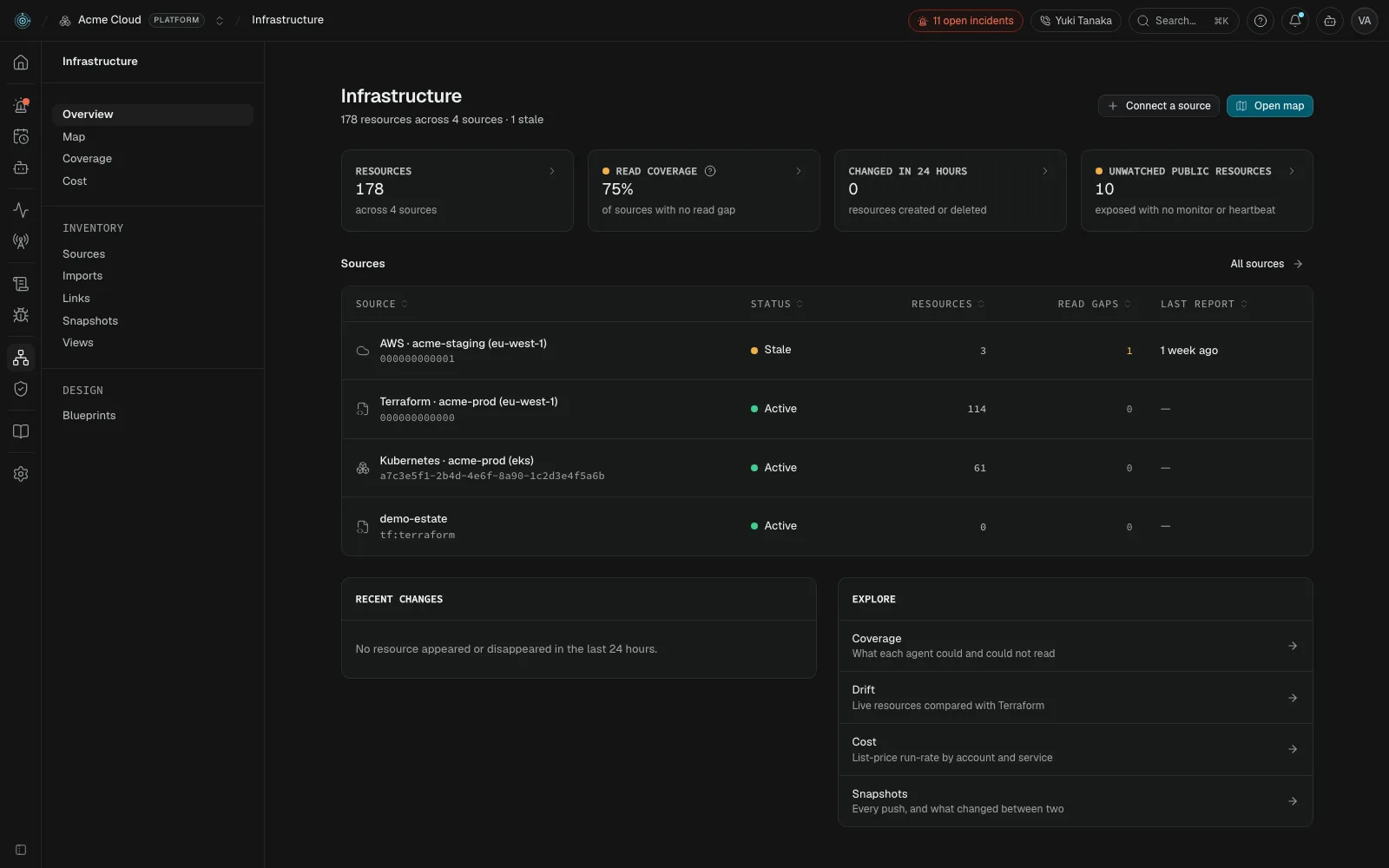
Eight screens, one inventory.
Overview
Sources, resources, coverage and what changed in the last 24 hours.
Live map
Pan, zoom, filter and group the estate, then export it as an isometric SVG.
Saved views
A filter and a grouping, saved and shared with the workspace.
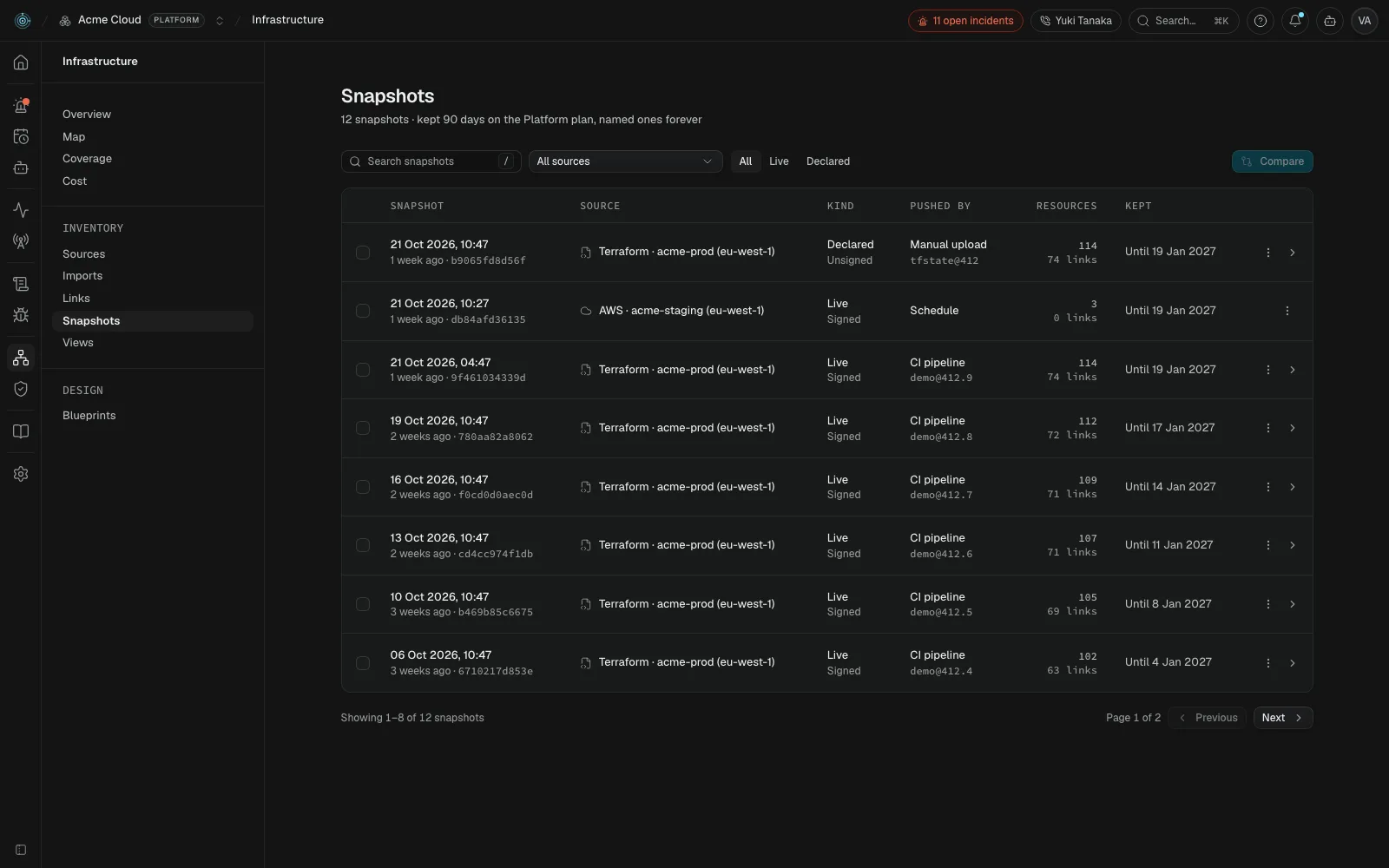
Snapshots & history
Every version an agent pushed, and the diff between any two.
Blueprints
A design a human authored, with its own geometry (Platform).
Clusters & accounts
Approve a new agent by key fingerprint, rotate keys, set cadence.
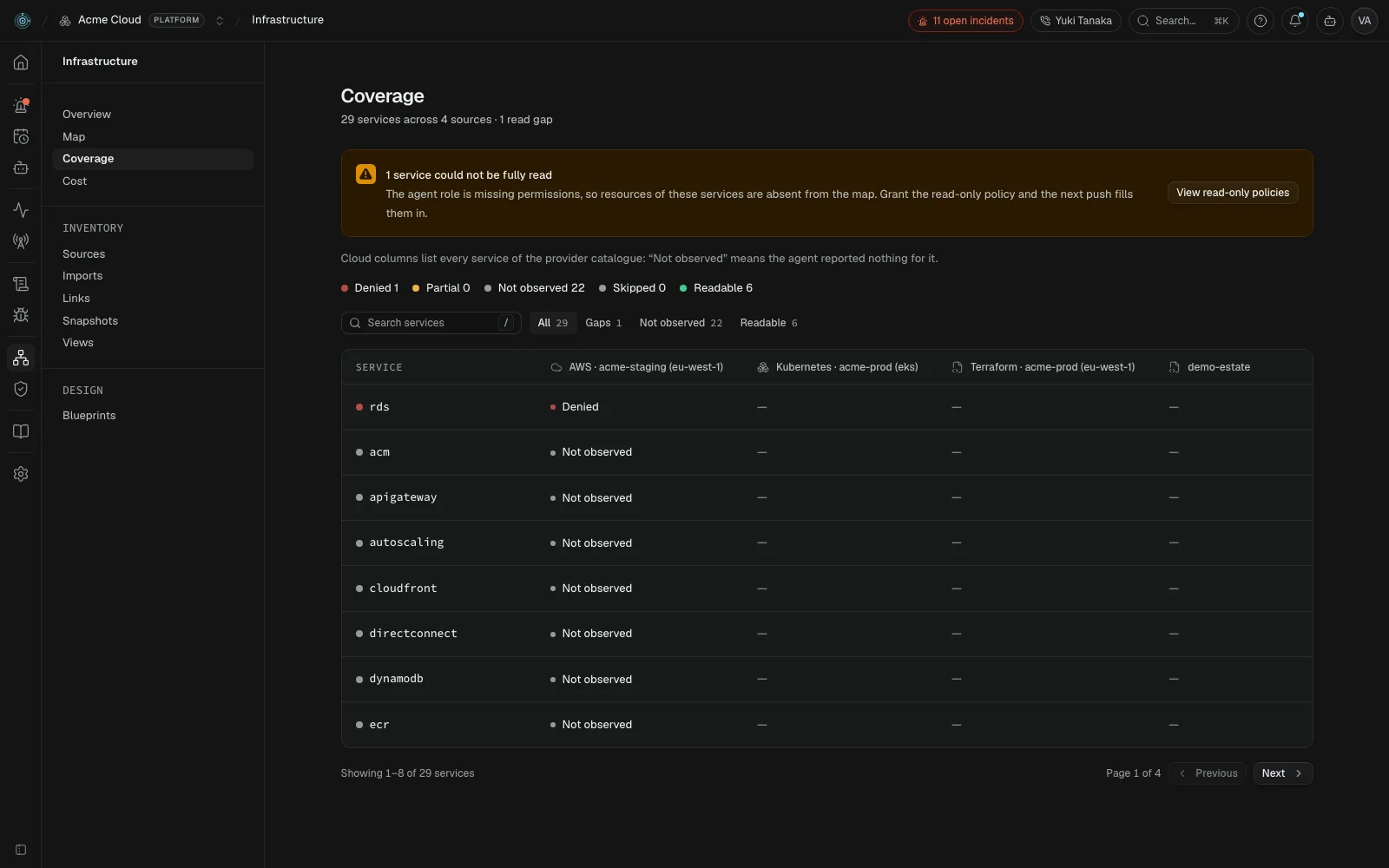
Coverage
What each account actually let the collector read.
IaC imports
Terraform and OpenTofu state and plan, as declared inventory.
How the inventory arrives
Four ways in. None of them is “give us a key”.
Every collector you run holds its own read-only identity, and signs what it pushes with an Ed25519 key you approve by fingerprint the first time it appears. A Terraform state you upload in the browser is the one exception: your session authenticates it, and the map labels it an unsigned import rather than pretending otherwise.
Kubernetes
One sidecar in the Mihari collector chart. Read-only RBAC on nodes, pods, services, ingresses and volumes — never secrets, never config maps.
helm upgrade --set cloudmap.enabled=true
AWS account
A read-only agent you deploy into your own account with the Terraform module — Lambda by default, Fargate for large estates. It trades a single-use enrolment code for its ingest token on first run.
terraform apply — Terraform 1.11+
Host or VM
A long-running agent that discovers on the interval the server hands back, and sends a heartbeat instead of a snapshot when nothing moved.
cloudmap agent
CI pipeline
Terraform and OpenTofu state or plan JSON, pushed from CI or uploaded in the browser. Declared inventory is kept apart from what is actually running, so drift is visible rather than averaged away.
cloudmap import tf --state | --plan
Overlays
The same map, answering nine different questions.
An overlay paints the boxes you already know with something else you already own in Mihari — monitor state, telemetry, errors, security findings, what changed. Every badge carries where it came from and how confident that link is, so the inspector can explain a badge instead of asserting it.
- Infrastructure
- Monitors
- Telemetry
- Errors
- Security
- Coverage
- Changes
- Declared Platform
- Plan Platform
Platform-only overlays are shown disabled on the Free plan, never hidden.
Snapshots & history
“What changed before the incident?” Answered from the estate itself.
Identical pushes are folded onto one row, so the history reads as a list of changes rather than a list of polls. Compare any two snapshots and you get the resources added, removed and changed, with a per-attribute delta. An incident page links to the infrastructure changes inside its own window.
- Every push kept as a snapshot; identical pushes coalesce into one row
- Compare any two snapshots — added, removed, changed, with attribute deltas
- 7 days of change history on Free, 90 days on Platform
- Label a snapshot so a release is findable months later (Platform)
- Infrastructure changes surfaced on the incident timeline
Coverage
A map you can believe says what it could not see.
A service missing from the map is missing for a reason, and Coverage is where the reasons are told apart: denied by IAM, partially read, never seen, deliberately skipped, or read cleanly. A source that stops pushing is marked stale on the overview, in the section sidebar and on its own page, and the overview says plainly that the map is the last inventory pushed rather than what is running now — a quiet agent never passes for an empty account.
- One row per service, one column per account or cluster
- Denied, partial, not seen, skipped or read — never a silent gap
- A source that stops pushing is marked stale everywhere it appears
- Least-privilege read policies published by the open-source engine
Exports & API
Your inventory leaves in a format someone else can read.
SVG and scene JSON download straight from the map, on every plan. PNG, draw.io, D2 and Mermaid are rendered by a worker and collected when they are ready. The same estate is readable over the REST API and, for the AI SRE, over MCP — when you have turned that on.
| Format | How | Plan |
|---|---|---|
| SVG | Downloads from the map | Every plan |
| Scene JSON | Downloads from the map | Every plan |
| SVG (isometric) | Downloads from the map | Platform |
| PNG | Rendered by a worker, collected when ready | Platform |
| draw.io | Rendered by a worker, collected when ready | Platform |
| D2 | Rendered by a worker, collected when ready | Platform |
| Mermaid | Rendered by a worker, collected when ready | Platform |
| REST API | Scopes, resources, graph, snapshots, diffs | Every plan (writes: Platform) |
Sovereignty
Mihari holds no cloud credentials in the default path.
Discovery runs on your compute, under your identity. The collector reads its own account or cluster with a read-only role you created, and pushes a snapshot signed with a key that never leaves your side. Mihari stores what arrives; it never calls an AWS or Kubernetes API on your behalf.
The collector holds the identity
A read-only IAM role or Kubernetes ClusterRole in your account, created by you. Mihari has no copy of it.
Nothing is polled from your cloud
Every byte in the map was pushed to Mihari by something you started. There is no outbound connection from Mihari into your network.
Signed, and confirmed by a human
A new agent key is pinned on first sight and stays pending until an owner or admin confirms its fingerprint. A leaked ingest token alone cannot forge topology.
One setting can send a slice of that inventory outside the EU hosting boundary, and it is off until an owner turns it on.
Questions, and what is not here yet.
Is there a one-click CloudFormation template?
Can I map Azure or Google Cloud?
Does Mihari put a price on my resources?
What is free, and what needs Platform?
Can the AI SRE read my inventory?
Draw the estate before the next incident does it for you.
One account or cluster, 500 resources and 7 days of change history are free. No cloud credential ever reaches Mihari.